E-Stamp Sindh 2026: Online Stamp Paper, Challan & Property Registration Guide
Learn how E Stamp Sindh works in 2026. Generate Challan 32-A, pay online, obtain and verify e-stamp paper, understand stamp duty, and follow the Sindh property registration process.

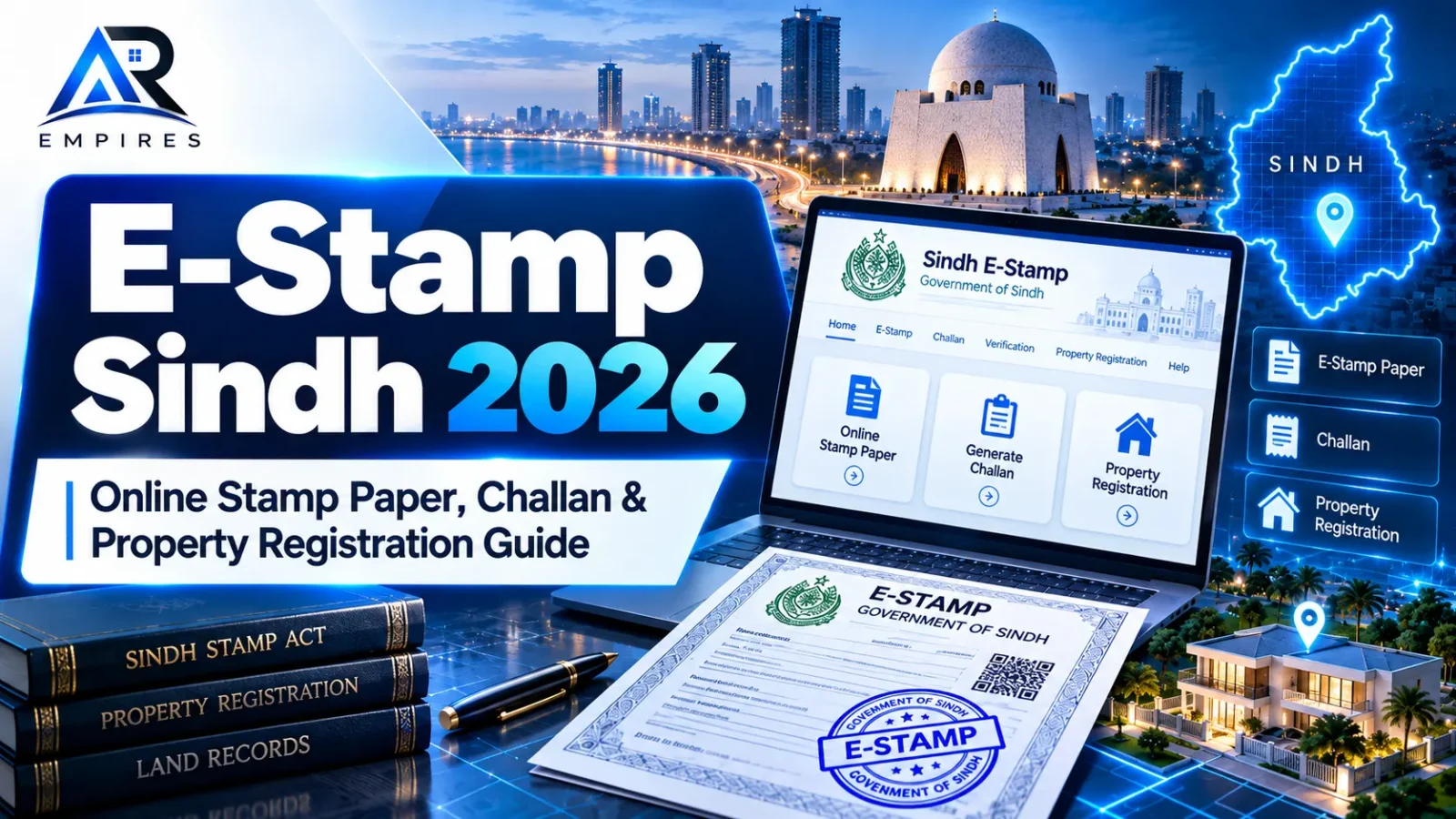
E Stamp Sindh is the Government of Sindh's electronic stamping system for generating Challan Form 32-A, paying applicable stamp duty and transaction charges, obtaining e-stamp paper and verifying issued stamps online.
For property transactions, the basic process is:
Choose the correct deed → enter property and party details → generate Challan 32-A → check valuation and payable charges → make payment → obtain the e-stamp → verify it → complete property registration.
The system makes stamp-paper transactions easier to track, but buyers and sellers still need to enter the correct property value, CNIC details, deed type and transaction information.
This guide explains how e stamp Sindh works in 2026, including online stamp paper, challan generation, payment, verification, stamp duty and property registration.
E Stamp Sindh 2026
| Question | Answer |
|---|---|
| Can you generate a Sindh e-stamp challan online? | Yes |
| Which challan is commonly used? | Challan Form 32-A |
| Can you pay electronically? | The current portal provides online payment options |
| Can Sindh e-stamps be verified online? | Yes |
| Can property valuation be checked? | Yes |
| Is e-stamping the same as property registration? | No |
| Does an e-stamp prove property ownership? | No |
What Is E Stamp Sindh?
E stamp Sindh is an electronic system used for paying and recording stamp duty on applicable documents and transactions.
Instead of relying entirely on manually purchased stamp papers, users can generate the required transaction challan electronically and enter information related to:
applicant;
purchaser;
seller;
CNIC;
deed type;
district;
taluka;
property address;
land area;
land classification;
property value;
applicable government charges.
For property transactions, the system can also use official valuation information to calculate the amount on which relevant duties are applied.
Once the required process is completed, an electronic stamp certificate can be issued and later verified through the government system.
How to Get E-Stamp Paper Online in Sindh
To start the e-stamppaperprocess in Sindh, use the official Sindh e-Stamping system.
Step 1: Open the Sindh E-Stamping Portal
Go to the official Government of Sindh e-stamping service.
Choose the service that matches what you need.
The portal includes options for:
Challan Form 32-A;
registration-related fees;
mutation fees;
scanning and copying fees;
valuation;
challan verification/reprinting;
e-stamp verification.
Do not use an unknown website simply because it appears above the government portal in search results.
Step 2: Select the Correct Stamp Paper and Deed Type
The system asks for the stamp-paper type and relevant deed.
For a property transaction, make sure you choose the legal instrument that actually applies.
For example, the portal specifically directs users to use Conveyance for a sale deed.
Do not select a deed merely because someone else used it for a different transaction.
Step 3: Enter Applicant and Party Information
You may need information about:
person generating the challan;
purchaser;
seller;
person paying the duty.
Enter CNIC and names carefully.
Incorrect party information can create problems during payment, e-stamp issuance or registration.
Step 4: Enter Property Details
For property transactions, information can include:
district;
taluka;
Deh;
property address;
land type;
land classification;
area;
built-up area;
structure value;
government valuation;
transaction value.
Use the actual property documents instead of estimating these details.
How to Generate an E-Stamp Challan in Sindh
Sindh's system uses Challan Form 32-A for relevant stamp-duty and transaction payments.
To generate an e stamp challan Sindh:
Open the official portal.
Select Challan Form 32-A.
Choose the district and taluka.
Select the stamp-paper type.
Select the correct deed.
Enter applicant information.
Add purchaser and seller details where applicable.
Enter the property details.
Review the valuation.
Review all applicable duties and fees.
Generate the challan.
Save or print the challan and payment information.
Check everything before payment.
A misspelled name, incorrect CNIC, wrong property area or wrong deed can be much easier to fix before the challan is paid.
What Is Challan Form 32-A?
Challan Form 32-A is the government challan generated for applicable stamp-duty and transaction payments.
Depending on the transaction, it can contain:
challan number;
PSID;
stamp-paper type;
deed;
purchaser details;
seller details;
property details;
land value;
structure value;
stamp duty;
registration-related fees;
other applicable charges;
payment status.
The challan and the final e-stamp are related but are not the same document.
The challan is part of the payment process.
The e-stamp is issued after the required payment and issuance steps.
How to Pay an E-Stamp Challan in Sindh
The current Sindh system provides an online-payment option.
For online payment, the portal generates a PSID, which can be used through supported 1Bill payment channels.
The government portal's current instructions describe payment through participating banking channels, including ATM payment using the 19-digit PSID.
The portal also currently asks users to choose between supported issuing banks such as:
National Bank of Pakistan;
Sindh Bank.
When using the online-payment route, follow the current portal instructions for collecting the final e-stamp from the selected bank after payment.
Always save:
Challan 32-A;
PSID;
payment confirmation;
bank receipt where applicable;
final e-stamp certificate.
Do not transfer stamp-duty money into an individual's personal bank account.
Information Required for Sindh E-Stamp Paper
The information required depends on the type of document.
For a property transaction, prepare:
Buyer and Seller Information
full names;
CNIC numbers;
relevant contact information;
purchaser/seller status.
Property Information
district;
taluka;
property address;
Deh or relevant locality;
land area;
constructed area where applicable;
property classification;
transaction value;
government valuation.
Transaction Information
deed type;
consideration/value;
who is paying the duty;
relevant old-registry details where required.
Enter the information exactly as it appears on the legal documents.
How to Verify E-Stamp Paper in Sindh
After obtaining the e stamp paper Sindh, verify it independently.
The Sindh e-stamping system provides a Verification Through Web service.
Use the stamp number shown on the issued certificate and compare the returned information with the document you received.
Check:
e-stamp number;
status;
amount;
deed type;
applicant;
buyer and seller;
challan information;
property information where displayed.
Do not rely only on the QR code or appearance of the document.
For the complete province-by-province verification process, read AR Empires' E-Stamp Verification 2026: How to Verify an E-Stamp Online in Pakistan guide.
Can an E-Stamp Be Reused?
An issued e-stamp should be associated with its specific transaction and document.
Do not assume that an old, used or previously issued stamp can be reused simply because it still appears in an online search.
Always check its status and the transaction information recorded against it.
E-Stamp Sindh for Property Sale and Purchase
For property buyers, e stamping Sindh should be treated as one part of the wider transaction.
A safer property-sale sequence is:
Verify seller → verify property → confirm property value → prepare deed → generate challan → pay applicable duties → obtain e-stamp → verify e-stamp → register deed → confirm updated ownership record.
Before generating the challan, verify:
seller's identity;
ownership documents;
exact property description;
area;
previous ownership chain;
transferability;
relevant authority or society record.
Read AR Empires' Property Verification Online in Pakistan guide before paying token money or completing a property purchase.
Property Registration Process in Sindh
Sindh property registration is a separate legal process from obtaining the e-stamp.
The Board of Revenue Sindh currently provides online access to several registration-related services, including:
registry search;
online calculator;
property-registration checklist;
applicable laws and rules;
document-status search;
registration information.
Sindh also enacted a Registration (Amendment) Act, 2026, which forms part of the current legal framework for property registration.
For a typical transaction, the practical sequence is generally:
1. Verify the Property and Seller
Confirm the available ownership and land records before preparing the final sale documentation.
2. Prepare the Relevant Deed
The deed must accurately describe the parties, property and transaction.
3. Complete E-Stamping and Required Payments
Generate the challan and pay the current amount calculated for the transaction.
4. Complete Registration Requirements
Follow the applicable Board of Revenue/Sub-Registrar requirements for the specific property.
5. Verify the Registered Document
Use available Board of Revenue registry and document-status services where applicable.
6. Check the Ownership Record
Registration should not be confused with every subsequent land-record or authority update.
Confirm that the relevant ownership records have also been updated.
For a broader document checklist, read AR Empires' Property Documentation in Pakistan guide.
Stamp Duty in Sindh
Sindh stamp duty is not one universal percentage that applies to every document.
The payable amount can depend on:
type of instrument;
property value;
deed type;
property classification;
government valuation;
consideration written in the instrument;
current provincial law;
additional charges applicable to the transaction.
Sindh's current legal framework includes the Sindh Finance Act, 2026, effective from July 2026.
Because different documents can be taxed differently, do not take one stamp-duty rate from a blog and apply it to every transaction.
Use the amount calculated by the current official system for your exact deed and transaction.
Sindh Stamp Duty and Property Valuation
For property transactions, valuation is particularly important.
The Sindh e-stamping portal includes a land/property valuation facility.
Depending on the property, valuation can involve:
district;
taluka;
locality;
Deh;
property type;
land area;
land classification;
construction information.
The system currently notes that where the value recorded in the instrument is higher than the relevant valuation-table value, stamp duty can be calculated using the higher applicable value under the governing rules.
For an actual transaction, rely on the current calculation generated for the property rather than an old screenshot or rate table.
E-Stamp vs Traditional Stamp Paper in Sindh
| Feature | Traditional Process | E-Stamp Sindh |
|---|---|---|
| Record | Primarily paper-based | Electronic record |
| Challan | Manual processes possible | System-generated |
| Verification | More difficult | Online verification |
| Transaction data | Limited | Linked with digital record |
| Traceability | Lower | Higher |
| Property valuation | Separate/manual | Integrated into relevant workflow |
The biggest benefit is not simply that the stamp is printed electronically.
It is that the transaction can be linked with a government database and independently checked.
Common E-Stamp Sindh Problems
Challan Information Is Wrong
Do not pay until the information has been corrected.
CNIC Does Not Match
Compare the entered information with the original CNIC.
Wrong Deed Selected
Confirm the correct legal instrument before paying.
Property Value Looks Incorrect
Recheck the district, taluka, land classification, area and property type.
Payment Is Complete but Stamp Is Not Issued
Keep your challan, PSID and payment proof and follow the current bank/government process.
E-Stamp Cannot Be Verified
Check the stamp number first.
If it still cannot be verified, do not rely on it for a major transaction until the issue is resolved.
Final Thoughts
E Stamp Sindh has made stamp-paper transactions easier to calculate, pay and verify, particularly for property and legal documents.
But buyers should remember that obtaining an e-stamp is only one part of a safe property transaction.
The better sequence is:
Verify the seller → verify the property → check valuation → generate Challan 32-A → pay through the official channel → obtain the e-stamp → verify it → complete registration → confirm the final ownership record.
Use the official Sindh e stamp portal for current challans, valuation, payments and verification, and use the Board of Revenue Sindh services for relevant land and registration checks.
Do not rely on an old duty rate, unofficial calculator or document supplied only by the seller or dealer.
For a major property transaction, independently verify both the e-stamp and the property before making payment.
This guide is for general educational information and does not replace legal or tax advice. Stamp duty, fees, valuation tables and government procedures can change, so confirm the current requirements for your exact transaction.
أهم النقاط
- E Stamp Sindh allows applicable stamp-paper transactions to be processed through a digital government system.
- Challan Form 32-A is used for relevant stamp-duty and transaction payments.
- The current portal supports online payment using a PSID and supported 1Bill payment channels.
- Property details and official valuation can affect the amount used for duty calculations.
- Always review CNIC, buyer, seller, deed and property information before paying the challan.
- An e-stamp can be independently verified through Sindh's official Verification Through Web facility.
- E-stamping and property registration are separate parts of the transaction.
- Sindh's Board of Revenue provides registry searches, property records, registration tools and document-status services.
- There is no single Sindh stamp-duty rate that applies to every instrument and transaction.
- A verified e-stamp does not by itself prove that the seller legally owns the property.
الأسئلة الشائعة
What is e-stamp paper in Sindh?
E-stamp paper is an electronically issued stamp certificate linked with Sindh's government e-stamping system and used for applicable documents and transactions requiring stamp duty.
How can I get e-stamp paper online in Sindh?
Generate Challan Form 32-A through the official Sindh e-stamping portal, provide the required transaction information, complete the applicable payment and follow the current issuance instructions.
How do I generate an e-stamp challan in Sindh?
Open the official portal, choose Challan Form 32-A, select the correct deed and property details, enter the parties' information and generate the challan.
Where can I pay an e-stamp challan?
The current Sindh portal supports electronic payment through PSID/1Bill channels and provides bank-selection instructions for issuance.
How can I verify Sindh e-stamp paper?
Use the official Verification Through Web service and enter the stamp number printed on the certificate.
What documents are required for e-stamp paper?
Requirements depend on the transaction. Property transactions commonly require buyer/seller identification, CNIC information, property details, valuation information and the correct deed type.
Is e-stamp required for property registration in Sindh?
Applicable property documents must meet current stamping requirements before or as part of the registration process. The exact requirements depend on the transaction and instrument.
How much is stamp duty in Sindh?
There is no single amount for every transaction. Stamp duty depends on the document, property value, applicable valuation and current legal schedule. Use the amount generated by the official portal for the specific transaction.
How do I register property in Sindh?
Verify the property, prepare the correct deed, complete applicable e-stamping and payments, then follow the Board of Revenue/Sub-Registrar registration requirements for the property.
Can I get non-judicial stamp paper online in Sindh?
The Sindh e-stamping system supports relevant non-judicial e-stamp transactions. Select the correct stamp-paper and deed category in the official system.
What if the information on an e-stamp is incorrect?
Do not use an incorrect e-stamp for an important transaction. Contact the relevant e-stamping authority or issuing channel and follow the official correction or refund procedure applicable to the case.
Can an e-stamp be reused?
Do not assume an issued stamp can be reused. Check its current status and transaction details through the official verification facility.